
Flower Chiller Buying Guide for Florists, Wholesalers & Hotels in UAE
Buying the wrong flower chiller is an expensive mistake in the UAE. A unit sized for a boutique flower shop won’t survive a wholesale market’s daily turnover and a chiller built for cold storage doesn’t do a hotel lobby’s presentation any favors. The short answer: match the chiller to your business type first, then to your volume, then to your space — in that order. Get that sequence backwards and you either overspend on capacity you don’t use or undersize a unit that fails during your busiest season.
This guide walks through that decision from the buyer’s side — not the manufacturer’s — so you know exactly what to ask for before you request a quote.
Why “one size fits all” doesn’t work for flower chillers in the UAE
The temperature in Dubai, Abu Dhabi, and Sharjah often goes above 45°C during summer. The flower cooler designed for less harsh climatic conditions is not made to function in such high temperatures and hence the result is that of pressure on the compressor and poor flower storage condition. Every recommendation in this guide assumes UAE-specific engineering — tropicalized compressors, high-humidity evaporators, and anti-fog glazing — because that’s the baseline, not an upgrade.
The three buyer types below face genuinely different problems, even though they’re all buying “a flower chiller.”
Buyer Type 1: The Florist or Flower Shop
What you’re actually solving for: daily turnover, customer-facing display, and floor space that’s usually limited.
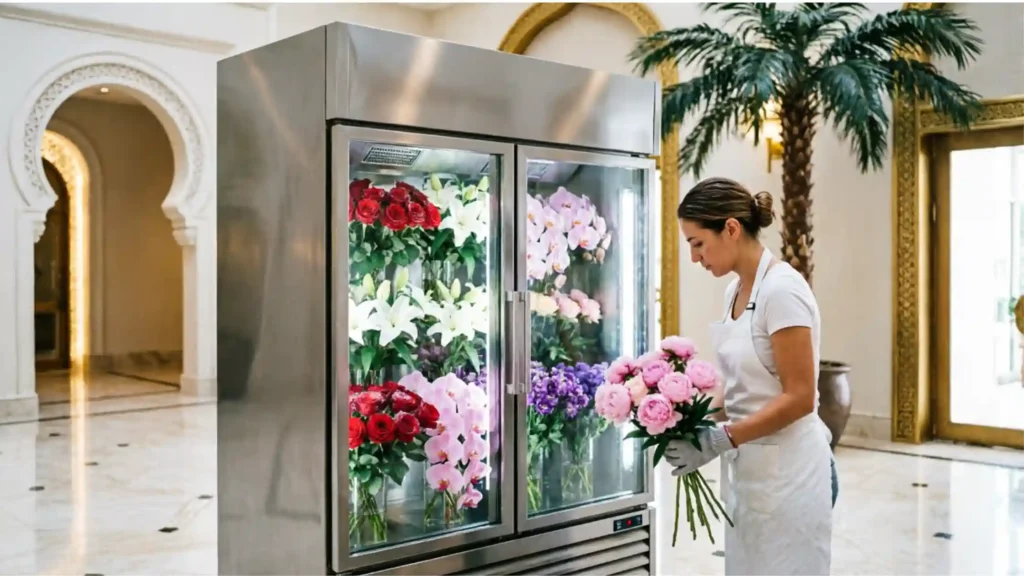
Florists typically buy on a retail footprint — the chiller is both storage and a selling display. That changes the priority order: visibility and presentation come close behind cooling performance, because a chiller full of flowers customers can’t see clearly isn’t earning its floor space.
What to check before you buy:
- Glass quality — look for anti-fog, double-glazed doors, not just any glass door. UAE humidity fogs standard glass within weeks.
- Shelving that adjusts for long-stemmed varieties (roses, delphiniums, gladioli) without cramming them.
- LED lighting rated “cool” — standard lighting adds heat load inside the cabinet.
- Footprint versus daily volume — a compact unit is fine for a boutique shop, but a shop doing wedding and event volume outgrows it fast.
If you’re a small to mid-sized florist, a single door flower cooler or double door unit usually covers daily retail volume without eating your shop floor. For a side-by-side breakdown of what changes between door configurations, our complete guide to choosing a flower chiller goes deeper into single, double, and triple door specs.
Buyer Type 2: The Wholesaler or Flower Distributor
What you are really calculating: volume, flow rate, and safeguarding the inventory while it is still in bulk form.
Wholesalers are not selling directly from the cooler like the florist does, so the importance of display glass does not really come into play. What becomes more important is the ability to process the stems efficiently, maintain consistent airflow and not upset the climate inside the cooler.
What to check before you buy:
- Walk-in capacity versus your peak-season volume, not your average week. Valentine’s Day and wedding season volumes can be multiples of a normal week.
- Airflow design — low-velocity, humidity-retentive airflow prevents dehydration across large stem quantities, unlike standard cold storage airflow.
- Door traffic tolerance — a wholesale operation opens and closes doors constantly during picking; the unit needs to recover temperature fast.
- Segmented zones if you’re storing multiple flower types with different ideal humidity ranges.
A walk-in flower chiller is the standard fit here rather than an upright cooler — it’s built for hundreds to thousands of stems and the kind of constant door traffic a distribution operation generates. If you’re weighing whether your volume actually justifies a walk-in versus an upright unit, this comparison is worth reading: walk-in cooler vs. floral refrigerator.
Buyer Type 3: The Hotel or Hospitality Buyer
What you’re actually solving for: consistent presentation across multiple points (lobby, event spaces, F&B outlets) without a dedicated florist on staff managing it hourly.
Hotels buy differently from florists and wholesalers because the chiller usually supports a broader hospitality operation — lobby arrangements, banquet and event floristry, restaurant table displays — often replenished by an external florist or in-house team on a schedule rather than continuously.
What to check before you buy:
- Noise levels, if the unit sits anywhere guest-facing (lobby, restaurant back-of-house adjacent to seating).
- Reliability and maintenance support — a hotel can’t have flowers wilting in a lobby during a live event because of a compressor issue. Ask about response time on emergency repairs, not just warranty terms.
- Multiple smaller units versus one central chiller, depending on whether florals are managed centrally or per outlet.
- Aesthetic fit if the unit is visible to guests — cabinet finish and glass quality matter more here than in a back-of-house wholesale setting.
Many hospitality buyers land on a single or double door unit for outlet-level storage, with a larger walk-in or custom-built cold room for centralized event floristry. If your space doesn’t fit a standard configuration — irregular back-of-house layouts are common in hotels — a custom floral cooling design is usually the more practical route than forcing a standard unit into the space.
Budget Considerations by Buyer Type
Pricing conversations go smoother when you already know where your money should be going, rather than just asking “how much does a flower chiller cost.”
For florists, most of the budget should go toward glass quality and lighting, since that’s what customers actually see and what drives impulse purchases at the counter. It’s tempting to save money here and put it toward a bigger unit, but an oversized chiller with poor display glass sells worse than a right-sized one that looks good.
For wholesalers, budget should weight toward capacity and airflow engineering over cosmetic finish, since the unit rarely faces customers directly. Where it’s worth spending more is on door recovery speed and segmented zoning if you’re storing multiple flower types — cutting corners here shows up as spoilage during peak weeks, which costs more than the upgrade would have.
For hotels, budget typically splits between the unit itself and a maintenance contract. A hospitality buyer without an AMC in place is exposed every time a compressor issue coincides with a live event, so factor ongoing maintenance into the total cost of ownership rather than treating it as an optional add-on after installation.
Across all three categories, the cheapest unit on paper is rarely the cheapest option over a 5–10 year working life once energy consumption, flower spoilage from poor humidity control, and repair frequency are factored in.
Common Buying Mistakes We See Across All Three Buyer Types
A few patterns repeat regardless of business type, and they’re worth flagging before you request a quote:
- Sizing for today’s volume instead of peak season. Wedding season, Valentine’s Day and major event periods can multiply normal volume several times over. A unit that comfortably handles an average week can be overwhelmed during peak weeks if it wasn’t sized with that in mind.
- Treating a flower chiller like a standard refrigerator purchase. Standard commercial refrigeration is optimized to dehumidify. Flowers need the opposite — a humid, low-airflow environment — so specs that look impressive on a generic fridge spec sheet (like aggressive dehumidification) actually work against flower preservation.
- Skipping the maintenance conversation until something breaks. Every buyer type benefits from knowing upfront what preventive maintenance is included, what emergency repair response time looks like, and what’s covered under warranty versus what isn’t.
- Not accounting for UAE-specific climate engineering. A chiller that performs fine in a showroom on a mild day can behave very differently once it’s running continuously against 45°C ambient heat for months. Always confirm tropicalized compressor specs rather than assuming standard commercial refrigeration will hold up.
Quick Comparison: Which Chiller Fits Which Buyer
| Factor | Florist / Shop | Wholesaler | Hotel / Hospitality |
| Primary use | Storage + customer display | Bulk storage, high turnover | Multi-point presentation |
| Typical unit | Single or double door | Walk-in chiller | Single/double door + custom cold room |
| Priority feature | Anti-fog glass, LED display | Airflow, capacity, door recovery | Reliability, noise, maintenance response |
| Buying mistake to avoid | Undersizing for event volume | Underestimating peak-season volume | No emergency repair plan |
The Non-Negotiables, Regardless of Buyer Type
A few specifications matter no matter which category you fall into, because they’re dictated by the UAE climate rather than your business model:
- Tropicalized compressor. A standard compressor rated for temperate climates will struggle in UAE summer ambient temperatures and shorten the unit’s working life.
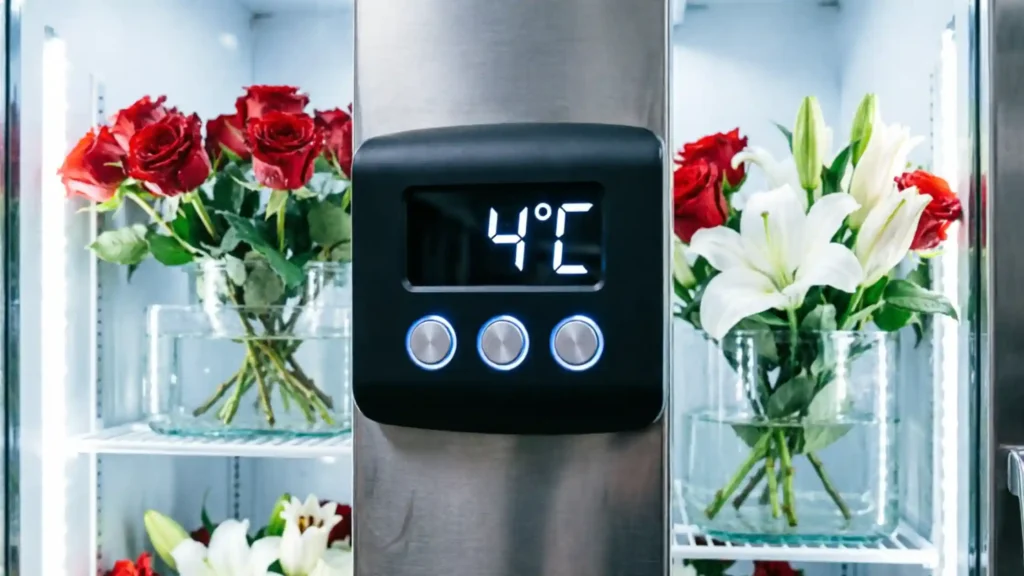
- Humidity control, not just temperature control. Most cut flowers hold up best between roughly 2°C and 8°C with humidity in the 80–90% range. A chiller that only manages temperature — like a standard beverage fridge — actively dehydrates flowers rather than preserving them.
- A real maintenance plan. Condenser coils will require cleaning from time to time due to high levels of dust in the UAE, while door gaskets should be inspected for leaks. Always check with the supplier whether or not they cover their products with an AMC.
Questions to Put to Any Supplier Before You Buy
Whichever buyer category you fall into, these five questions separate a supplier who understands floral refrigeration from one who’s repurposing standard commercial refrigeration:
- Is the compressor tropicalized for UAE ambient conditions, or is it a standard commercial unit?
- What humidity range does the unit maintain, and how (evaporator design, not just a stated number)?
- What’s your typical installation timeline for a standard unit versus a custom or walk-in build?
- What does your maintenance and emergency repair coverage actually include?
- Can I see the unit’s performance for my specific flower types, not just a general spec sheet?
Getting a Quote That Actually Matches Your Business
The quickest method of getting an accurate quote is to come in with your type of business, your high season volume (not your weekly average), and your space or footprint figured out. They can measure your unit accurately on the first try if they know all of this at once, rather than through multiple tries.
FlowerChiller.ae designs and manufactures across all three buyer categories — from compact single door units for boutique florists to full walk-in cold rooms for wholesale distribution and custom builds for hotel back-of-house spaces. If you’re ready to size a unit for your specific operation, our team can walk through the numbers with you directly.